
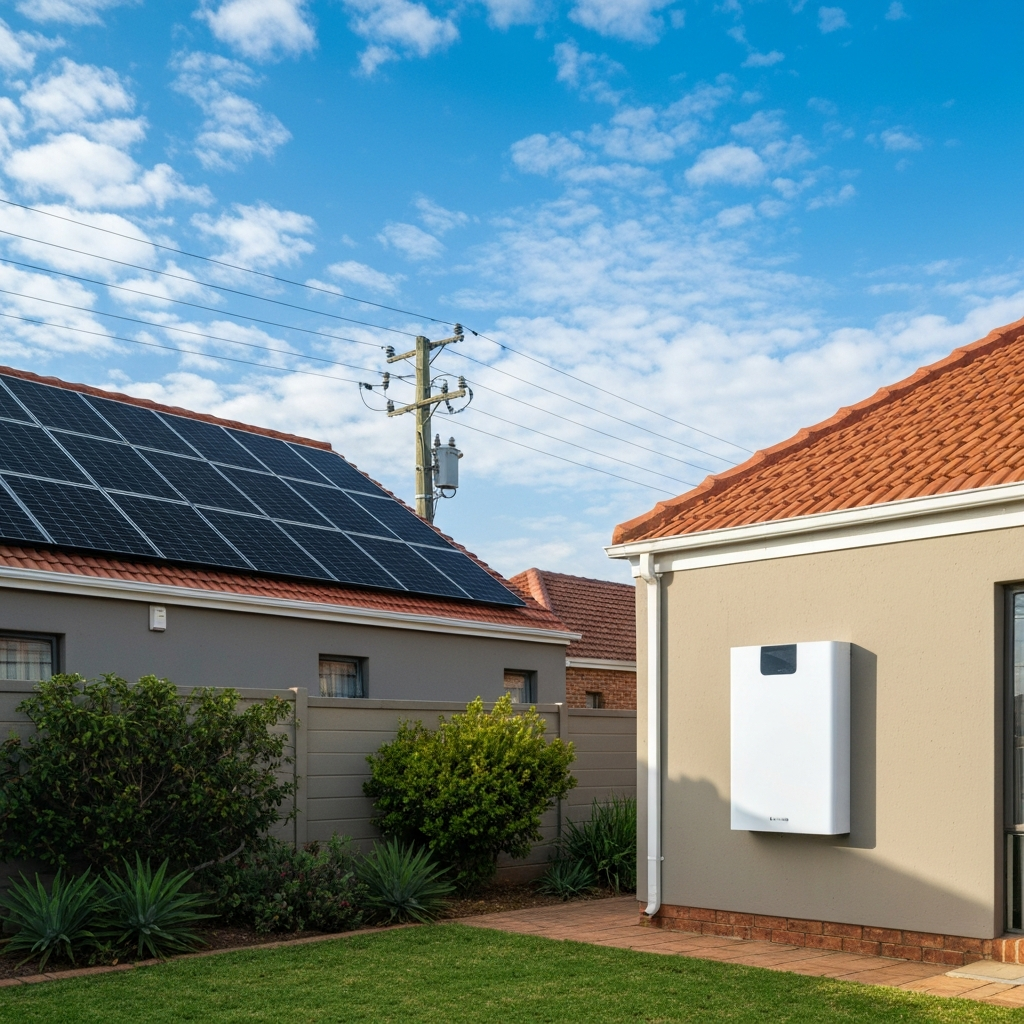
Selecting between grid-tied and off-grid architecture depends entirely on your daily energy consumption and tolerance for grid reliance. Grid-tied systems offer cost-effective savings while off-grid solutions demand massive battery banks for total independence.
Regulatory Standards for Renewable Energy in Gauteng
Going fully off-grid is a major engineering and financial challenge, often requiring massive energy reserves to survive low-light winter months. Most Johannesburg properties operate more efficiently on grid-tied or hybrid systems that leverage municipal power during poor weather.
However, exporting surplus power requires strict regulatory compliance. To prevent hazardous back-feeding and ensure safety, the municipality mandates:
- Registered Certificates of Compliance (COC): Verifying all wiring meets South African standards.
- Bi-directional Metering: Tracking electricity flow to and from the grid accurately.
- Anti-islanding Technology: Preventing your system from energizing street cables during blackouts.
- Municipal Registration: Ensuring your installation is legal and fully approved.
Adhering to these standards protects repair crews and secures your property. Avoid DIY installations, as they carry significant liability and will immediately invalidate your property insurance.
The Financial and Technical Reality of Off-Grid Systems
Achieving true energy independence requires a system designed for the most challenging weather scenarios. In Johannesburg, a week of persistent cloud cover and rain can quickly deplete standard battery storage. To maintain a reliable supply, the solar array and battery bank must be significantly over-engineered. This necessity for excess capacity leads to a much higher initial capital investment compared to standard grid-integrated solutions.
Matching Inverter Architecture to Your Property Demand
The inverter is the heart of your solar system, converting direct current into usable power for your property. Because it manages constant thermal stress, an undersized unit risks overheating or catastrophic failure.
To ensure reliability, we perform professional load profiling to specify the exact wattage you need:
- Inductive Starting Surges: We measure the high-amperage “kick” required to start motors like borehole pumps and air conditioners.
- Continuous Base Load: We factor in the 24/7 draw from essential systems like alarms, servers, and refrigeration.
- Battery Replenishment: We calculate the charging amperage needed to fully recover your storage during limited daylight.
- Phase Distribution: For commercial properties, we balance heavy loads across three-phase architecture to maintain stability.
Whether for a residential single-phase setup or a heavy industrial three-phase system, accurate sizing prevents your inverter from tripping when multiple appliances draw power simultaneously. This engineering-first approach ensures your property remains powered under all conditions.
Critical Load Assessment Factors
Proper engineering separates reliable installations from constant hardware failures. We assess specific electrical variables before recommending an inverter:
- The starting surge requirements of inductive loads like air conditioners.
- The continuous base load of servers, alarms, and refrigeration.
- The charging amperage required to replenish batteries during limited sunlight hours.
Secure Your Property with Power Plus Electrical
Choosing the wrong system architecture will cost you heavily in upgrades and replacements. Professional load profiling guarantees you get exactly the capacity you need. Invest in the peace of mind that comes with accurate engineering. Contact us today for a detailed site inspection and transparent quote.
FAQs
How much does a 5kW solar system cost in Johannesburg?
A standard 5kW grid-tied or hybrid system costs between R80,000 and R120,000. Going entirely off-grid with a 5kW inverter requires substantially more battery storage, pushing the total cost upwards of R160,000.
Do I need a permit or municipality approval for solar panels in South Africa?
Yes, all grid-tied and hybrid systems must be registered with the local municipality to ensure safety standards are met. Completely off-grid systems still require a structural assessment and a Certificate of Compliance.
Is installing solar cheaper than paying Eskom electricity tariffs?
Absolutely. A properly sized grid-tied system offsets your highest tariff usage blocks. The return on investment typically takes five years, after which you save thousands of rands annually against Eskom rates.